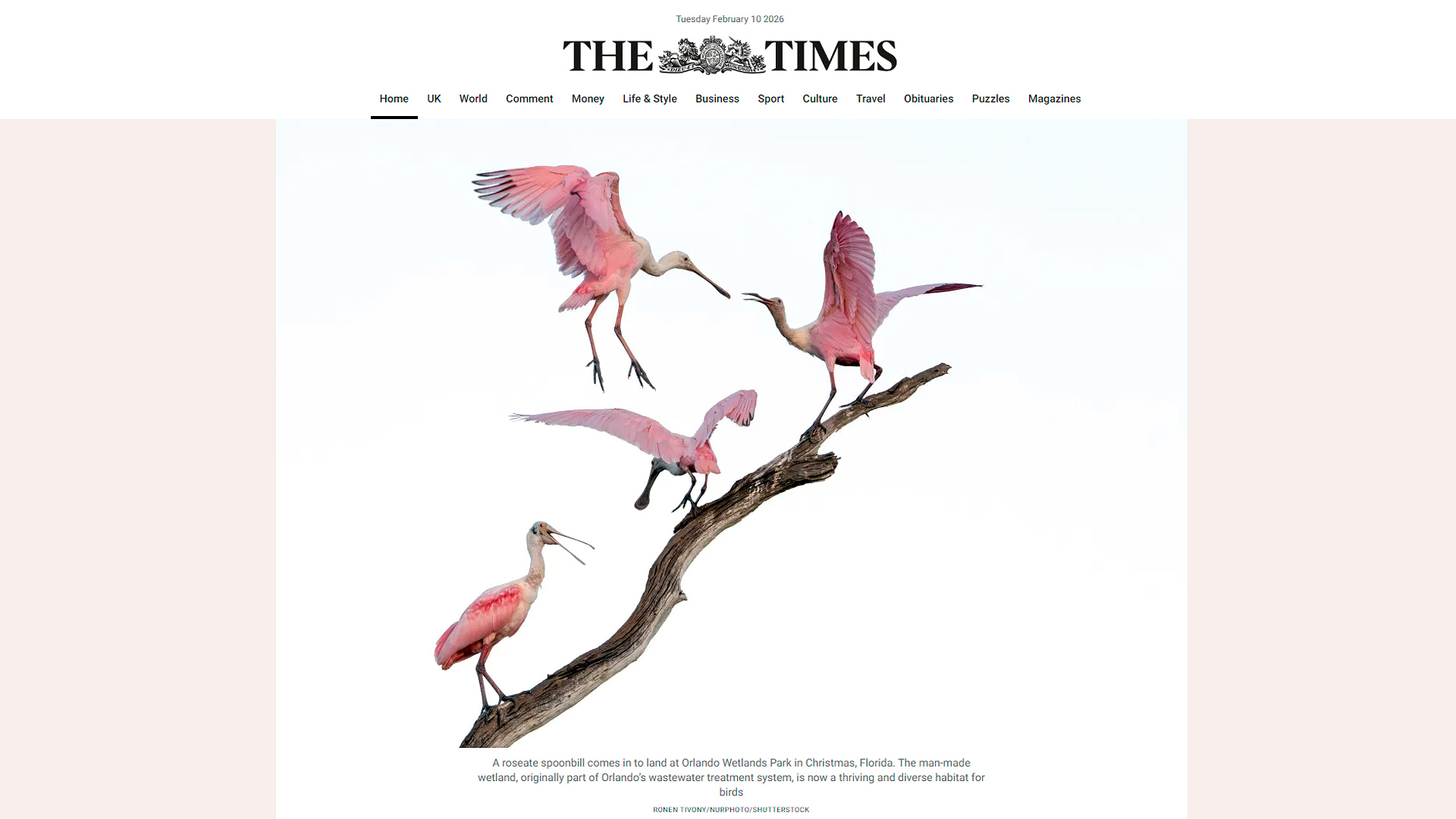
A roseate spoonbill comes in to land at Orlando Wetlands Park in Christmas, Florida. Photo: Ronen Tivony
The Times picture editors selected my roseate spoonbill landing photo from Orlando Wetlands Park for their global “Best-of News Pictures” gallery on January 19, 2026. View the feature in The Times: News Pictures of the Day
Orlando Wetlands Park: Spoonbill Paradise
Orlando Wetlands Park in Christmas, Florida – 45 minutes east of Orlando, transforms treated wastewater into 1,700 acres of prime wading bird habitat.
Roseate Spoonbills:
1. They Aren’t Born Pink
Just like flamingos, spoonbills get their color from their food. They eat a steady diet of shrimp and crawfish that are high in carotenoids (natural pigments). While they start life as pale, white-ish chicks, they turn a vibrant “neon” pink by the time they are three years old.
2. The “Prehistoric” Look
Adult spoonbills are actually bald. Once they reach maturity, they lose the feathers on the top of their heads, revealing greenish skin. This, combined with their ruby-red eyes, gives them a unique, prehistoric appearance that looks incredible in photos.
3. A Bill with “Radar”
Their spoon-shaped bill is a high-tech hunting tool. It’s lined with sensitive nerve endings that act like motion sensors. They sweep their heads back and forth in the water—a behavior called “head-swinging”—and the moment they feel a tiny shrimp, the bill snaps shut faster than a human can blink.
4. Straight-Billed Babies
Interestingly, spoonbill chicks are born with straight bills. The iconic “spoon” doesn’t start to flatten out until they are about nine days old. By the time they are six weeks old, the bill is fully formed and ready for scooping.
5. A “Bowl” of Birds
While a group of flamingos is a “flamboyance,” a group of spoonbills is called a “bowl.” If you’re lucky enough to see a whole flock take flight at once, that group is fittingly called a “scoop.”
6. Florida’s “Environmental Alarm”
Scientists call spoonbills an indicator species. Because they are so sensitive to water levels and quality, their health tells us exactly how well the Florida Everglades are doing. When the spoonbills are thriving, the whole ecosystem is usually in good shape.
About Ronen Tivony
As a professional wildlife photojournalist and a certified Florida Master Naturalist, Ronen Tivony brings a unique blend of technical expertise and ecological insight to the field. With over three decades of experience as a wire news photographer, his work has transitioned from covering global headlines to documenting the fragile beauty of Florida’s wild spaces.
A Career Defined by Excellence
Ronen’s photography is recognized globally, with images featured in premier publications such as National Geographic, The New York Times, The Guardian, The Atlantic, CNN, and BBC. In 2020, he was awarded a Fellowship of the Royal Photographic Society (FRPS), one of the highest honors in the photographic world, reflecting a lifelong commitment to visual storytelling.