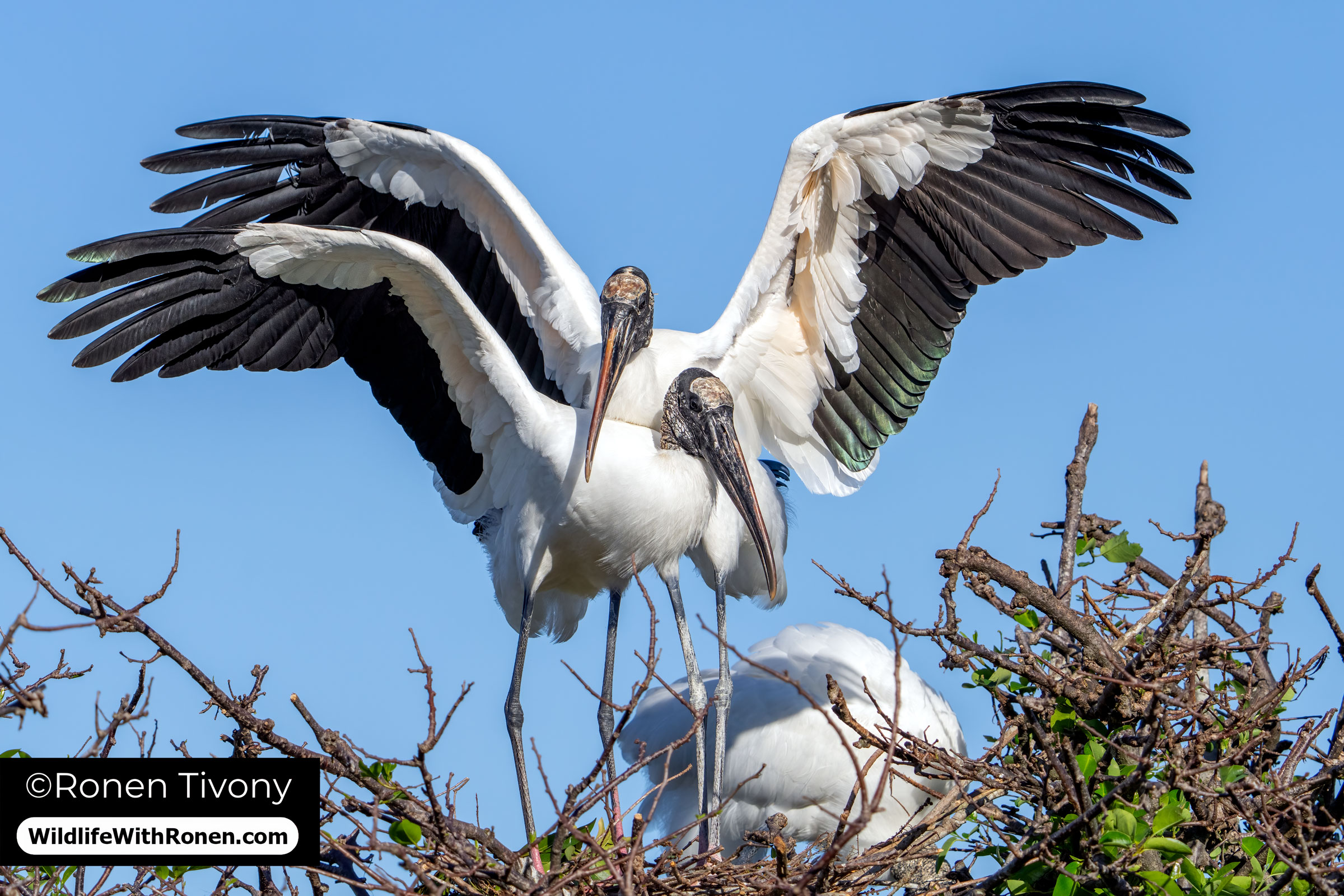

Why Wakodahatchee Is Wildlife Heaven
Wakodahatchee Wetlands is one of Florida’s most productive bird photography locations, with over 170 recorded bird species concentrated along a 0.75-mile boardwalk. The mix of open water, nesting islands, and close boardwalk access gives photographers intimate perspectives on breeding colonies, flight paths, and classic Florida wildlife like alligators and turtles.
For Wildlife With Ronen workshops, Wakodahatchee is a favorite because it offers consistent action, short walking distances, and a steady flow of teaching moments, perfect for both beginners and advanced wildlife photographers. As a Florida-based wildlife photojournalist and Certified Florida Master Naturalist, Ronen uses this site to show how understanding habitat design and bird behavior directly translates into stronger wildlife images
Best Time to Visit and Lighting
Timing your visit is crucial for both bird activity and optimal light conditions.
Peak Season (Late Winter/Spring): The best time for photography is generally December through May, which includes the peak nesting season (February through April). This period offers the highest concentration of breeding birds (e.g., Wood Storks, Great Egrets, Anhingas) and opportunities to photograph courtship displays and chicks.
Time of Day: Early Morning (Sunrise to 9:00 AM): This is the most recommended time. Birds are most active, and the soft, golden light provides excellent, flattering illumination for plumage. It also helps avoid the harsh midday sun and the high volume of daily walkers.
Late Afternoon (Golden Hour before Sunset): The light becomes warmer, offering opportunities for beautiful silhouettes, reflections, and artistic shots.
Target Bird Species
The wetlands host a stunning array of birds, many of which are accustomed to human presence on the boardwalk, allowing for remarkably close shots.
-
Wading Birds (Rookery Stars):
-
Wood Stork: A major rookery site, offering close-up nesting and flight shots, especially Feb–April.
-
Roseate Spoonbill: Highly sought-after for their distinctive bill and brilliant pink plumage.
-
Great Egret & Snowy Egret: Common, providing opportunities for capturing behavior and flight.
-
Anhinga: Frequently seen drying their wings, with chicks often visible during nesting season.
-
Various Herons: Including Great Blue, Little Blue, Tri-colored, and Green Herons.
-
-
Other Notable Species:
-
Purple Gallinule: Known for its vibrant colors and large yellow feet.
-
Black-bellied Whistling-Duck: Common waterfowl.
-
Raptors: Including Osprey and Red-shouldered Hawk.
-
Purple Martin: Arrive in winter to nest in dedicated birdhouses.
-
Essential Gear for Wakodahatchee Wildlife Photography
A long telephoto zoom lens, ideally 200-600mm, to capture detailed shots of birds at various distances, especially in flight or on nests farther away. This lens is the most important for flexible framing and sharpness.
A 70-200mm lens to photograph birds nesting right next to the boardwalk, offering excellent reach with portability and sharp focus for closer subjects.
A wide-angle lens to capture environmental shots that show birds within their habitat and context along the boardwalk or wetlands landscape.
This gear combination balances reach, detail, and storytelling opportunities while accommodating varying distances and photographic goals at Wakodahatchee Wetlands.
Stability: Due to the narrow boardwalk and frequent foot traffic that can cause vibrations, a monopod is often preferred over a tripod for stabilizing a long lens. Handheld shooting is also common and effective.
Essentials: Extra batteries, multiple memory cards are a must. Binoculars are also recommended for scouting and observation.
Photo TIp: Focus on Behavior
Look for compelling actions like feeding, courtship displays, chicks in the nest, or interaction between birds.

Recommended Camera Settings for Florida Bird Photography
Shutter Speed
When teaching at Wakodahatchee, the starting point for most bird photography is shutter-priority or manual with auto ISO, aiming for at least 1/2000s for birds in flight and active feeding sequences.
For perched birds and nest interactions, dropping shutter speed to around 1/1000s with an aperture of f/7.1–f/8 provides extra depth of field, keeping multiple chicks and parents sharp without sacrificing too much speed.
Continuous Autofocus Mode for Birds in Flight
Use continuous autofocus (AF-C/AI Servo) with zone autofocus area when tracking birds in flight, the zone helps maintain lock on erratic motion. For perched birds, switch to a smaller and more precise autofocus area to avoid distracting twigs/branches pulling focus forward.
High Frame Rate Shooting for Birds in Flight and Dynamic Moments
For birds in flight, takeoffs, landings, and high-energy behaviors like fighting, fishing, or hunting, shoot at the highest frames per second (fps) your camera supports. Burst mode dramatically increases your odds of capturing the decisive moment, a perfectly extended wing, an osprey’s talons gripping prey, or a Wood Stork’s final approach to the nest.
Enable Bird Eye Autofocus
If your camera has bird eye autofocus, enable it, this detects and prioritizes the bird’s eye for critically sharp photos.
Why Join a Wakodahatchee Photography Workshop
A guided bird photography workshop at Wakodahatchee compresses years of trial-and-error into a single, focused session. With one-on-one coaching from an award-winning wildlife photojournalist and Fellow of the Royal Photographic Society, you get real-time feedback on exposure, autofocus setup, composition, and field craft while standing in front of active nests.
Workshops are kept to small groups or private sessions, so instruction can match your experience level, from first-time wildlife photographers learning the exposure triangle to advanced shooters fine-tuning birds-in-flight sequences for portfolio work. Many visitors pair Wakodahatchee with additional wildlife photography workshops at Orlando Wetlands, Everglades National Park, or St. Augustine Alligator Farm for a multi-day Florida bird photography adventure
About Ronen Tivony: Florida Wildlife Photography Expert
Ronen Tivony is an award-winning wildlife photojournalist, Fellow of the Royal Photographic Society, and Certified Florida Master Naturalist. With decades of experience, Ronen brings a unique blend of photojournalism storytelling and deep ecological knowledge to every wildlife photography workshop. His work has appeared in The New York Times, The Wall Street Journal, BBC, TIME, CNN, The Smithsonian, Rolling Stone, The Guardian, The New Yorker, and National Geographic.
As a Florida resident and Certified Florida Master Naturalist, Ronen shares not only camera techniques but also insights into animal behavior, habitat dynamics, and conservation. Whether leading private one-on-one sessions or small group workshops, Ronen provides immediate in-field feedback and tailored instruction, helping photographers at every level capture the decisive moments that define Florida’s wild side.
Join Ronen Tivony for an immersive wildlife photography experience that combines professional standards, storytelling expertise, and a passion for Florida’s natural wonders.
If you enjoyed this post, you can explore my full portfolio of published wildlife photography or check out my upcoming Florida photography workshops to improve your own field craft.