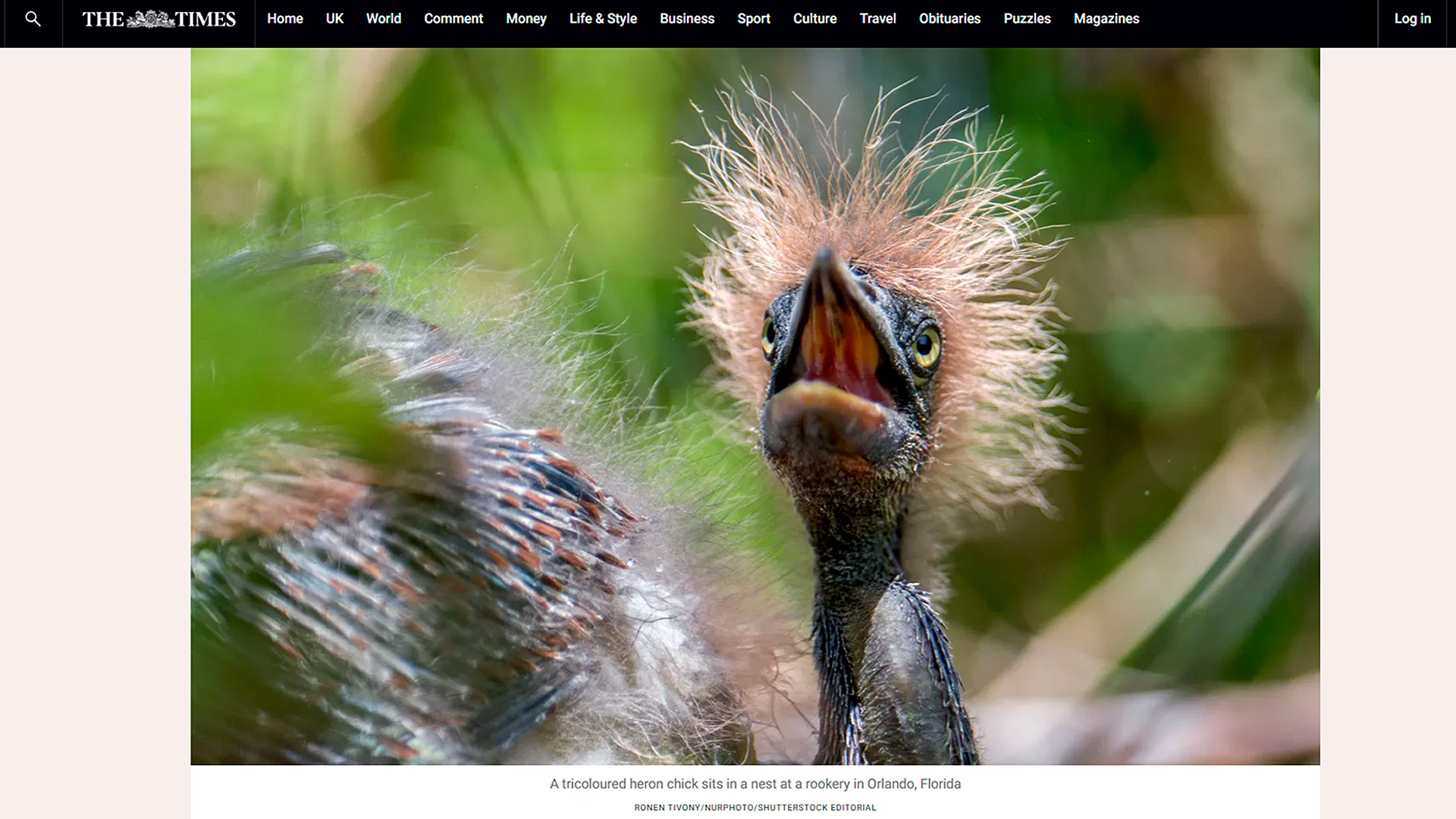
A photograph of a tricolored heron chick sitting in a nest at a rookery in Orlando, Florida, taken by wildlife photojournalist Ronen Tivony, has been selected and published by The Times of London. Picture editors at The Times review photographs submitted from around the world each day and choose only a handful to feature.
A Tricolored Heron Chick in the Heart of Orlando
Ronen captured this image at one of Orlando’s active rookeries during nesting season. Herons, egrets, and wading birds gather here in large numbers to raise their young. Tricolored herons are striking at every life stage. But chicks offer some of the most compelling photographic opportunities. They are fluffy, wide-eyed, and perched with an almost comical confidence.
Florida’s rookeries attract dozens of nesting species in close proximity. Orlando’s wetland areas rank among the most accessible and productive in the state. Wildlife photographers find them ideal for documenting behavior that is difficult to observe anywhere else.
Selected by The Times Picture Editors
The Times publishes a curated selection of news photographs each week. Experienced picture editors choose images for their visual impact, storytelling quality, and technical excellence. Selection from that global pool is a meaningful benchmark for any photojournalist.
Ronen’s work has appeared in National Geographic, The Guardian, CNN, BBC, Smithsonian Magazine, and The New York Times. This latest placement in The Times continues that record.
About the Tricolored Heron: Florida’s Most Elegant Wading Bird
The tricolored heron is one of Florida’s most elegant wading birds. It is slender, long-necked, and immediately recognizable. Adults display a striking combination of blue-gray, lavender, and white plumage. A clean white stripe runs down the front of the neck. The belly is bright white. During breeding season, the colors intensify. The bill turns bright blue with a black tip, and the lores display a vivid cobalt-blue patch. Few wading birds in Florida undergo such a dramatic seasonal transformation.
Tricolored herons are active, energetic hunters. They do not stand and wait like great blue herons. They run after fish with sharp turns and stops, balancing with their wings, and often crouch so low before striking that their belly touches the water. Watching one hunt is one of the most dynamic experiences in Florida bird watching.
Follow Ronen Tivony’s Published Work
This publication in The Times joins an impressive list of editorial placements in some of the world’s most respected outlets, National Geographic, The Guardian, CNN, BBC, Smithsonian Magazine, and The New York Times, among others. Each image represents hours in the field, an intimate knowledge of animal behavior, and a commitment to documenting Florida’s wildlife with honesty and precision.
Florida’s wetlands are home to world-class subjects: tricolored herons, reddish egrets, snowy egrets, roseate spoonbills, wood storks, and dozens of other species that draw photographers from around the globe. Orlando’s rookeries, in particular, are among the best places in the country to witness and photograph nesting behavior up close, and it is this kind of access, season after season, that makes Ronen’s published work as consistent as it is compelling.
To see the full collection of Ronen’s editorial placements, visit the Published Work page.
Explore Florida’s Rookeries on a Wildlife Photography Workshop
If you have ever wanted to photograph nesting herons, egrets, and spoonbills in Florida, a guided wildlife photography workshop is the most efficient way to get started. Ronen leads private and small-group workshops at carefully selected locations across the state, including Orlando Wetlands, Wakodahatchee Wetlands, the Everglades, and Fort De Soto Park.
Whether you are new to wildlife photography or looking to take your technique to the next level, the workshops offer hands-on guidance from a working photojournalist.