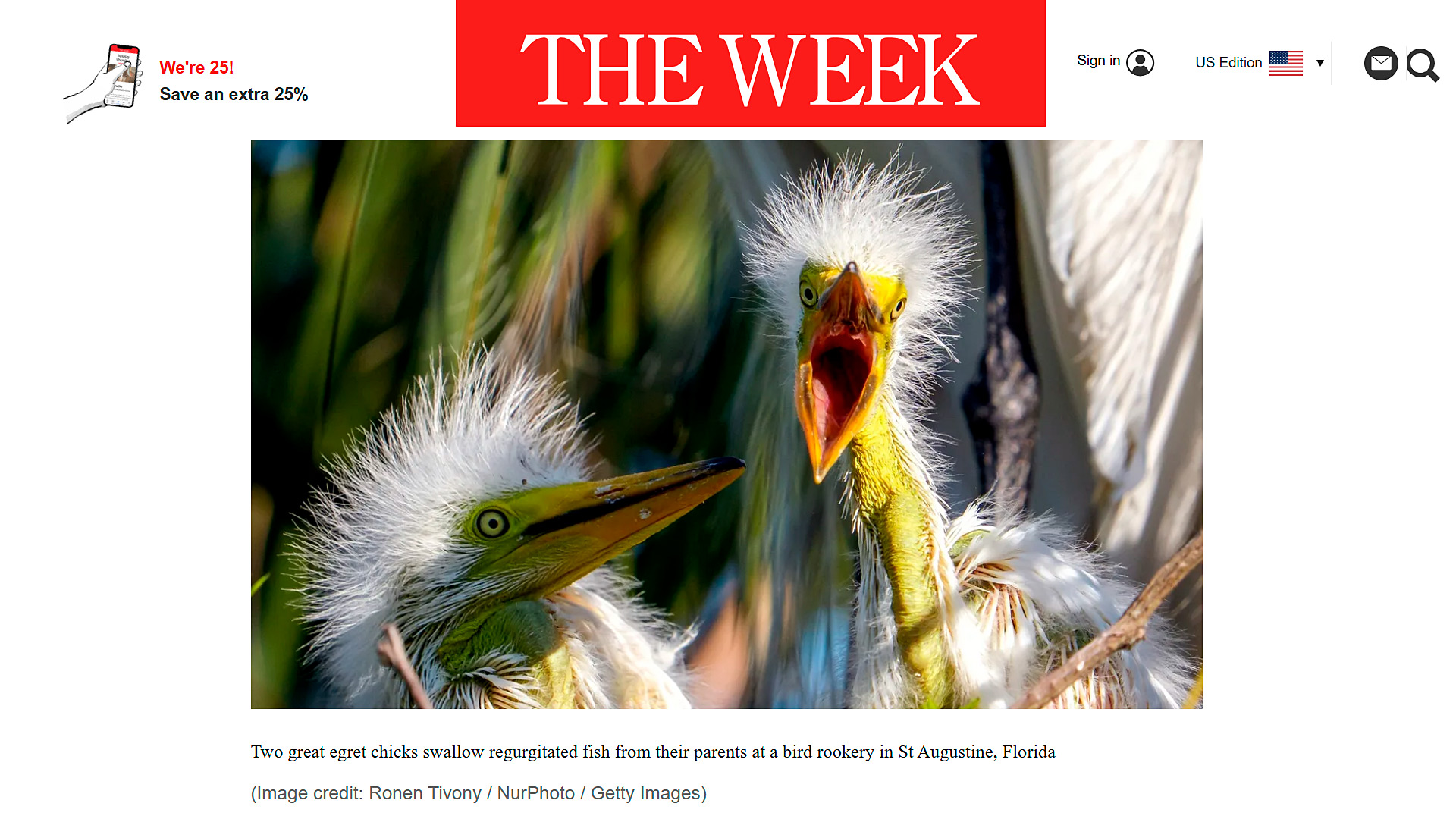
Great egret photography in Florida never gets old. This week, it led to a publication I am happy to share. My photograph of two great egret chicks swallowing regurgitated fish from their parents was selected for The Week Magazine, “Best Photos” gallery, published April 24, 2026.
The published caption read:
“Two great egret chicks swallow regurgitated fish from their parents at a bird rookery in St Augustine, Florida. Photo: Ronen Tivony”
Why Florida Is the Best Place for Great Egret Photography
Great egret photography in Florida is exceptional for one simple reason: access. The state’s established wildlife refuges, wetland boardwalks, and colonial nesting rookeries give photographers close, legal, ethical access to nesting birds. That kind of access does not exist in most other parts of the country.
Great egrets (Ardea alba) are large, all-white wading birds. According to the Cornell Lab of Ornithology, they stand around three feet tall with a wingspan of roughly 55 inches. They are year-round residents across much of Florida. During nesting season they gather in mixed-species rookeries alongside herons, ibis, roseate spoonbills, and wood storks. One location, one morning, multiple species. For photographers, this is extraordinary.
The best locations for great egret photography in Florida include:
- St. Augustine Alligator Farm Zoological Park – the premier rookery photography destination in northeast Florida, with nesting great egrets, roseate spoonbills, herons, and wood storks
- Wakodahatchee Wetlands, Delray Beach – a boardwalk sanctuary with reliable egret nesting activity and excellent morning light
- Green Cay Wetlands, Boynton Beach – close-range nesting behavior in a beginner-friendly setting
- Orlando Wetlands Park, Christmas – a hidden gem for wading bird photography in central Florida
- Corkscrew Swamp Sanctuary, Naples – old-growth cypress rookery with dramatic nesting scenes
- Stick Marsh, Fellsmere – a top destination for wading bird photography, with egrets foraging in the shallows
- Everglades National Park – remote and spectacular for the more adventurous photographer
Spring nesting season runs roughly from February through May in Florida. That is your window for great egret chick photography at its best.
The Week Image: Two Egret Chicks at the St. Augustine Rookery
The photograph published in The Week was made at the colonial waterbird rookery in St. Augustine during spring nesting season. It captures two great egret chicks mid-feeding, bills open wide, necks stretching toward a parent that has just arrived at the nest.
Great egret chicks are fed entirely by regurgitation. According to the Audubon Society, both parents share feeding duties throughout the nesting period. A parent arrives, lowers its head, and the chicks lunge and grab at the bill. The transfer happens in seconds. It is fast, chaotic, and visually powerful. It is also one of the most compelling scenes that great egret photography in Florida has to offer.
St. Augustine’s rookery is one of the most productive sites in the state for this kind of image. Dozens of great egret nests are active simultaneously during peak season. The birds have nested at this location for decades. They are largely undisturbed by photographers positioned at the designated viewing areas below.
Understanding the Great Egret: What Every Florida Photographer Should Know
Great great egret photography in Florida starts with knowing your subject. These birds are visually spectacular. Their behavior during nesting season is equally extraordinary.
Size and appearance: Great egrets are large birds. They stand around three feet tall with a wingspan of approximately 55 inches, according to the Cornell Lab of Ornithology. Their plumage is entirely white. They have a long yellow bill and black legs and feet. That combination of yellow bill and black legs is one of the key field marks separating them from snowy egrets, which have a black bill and distinctive yellow feet.
Breeding plumage: During nesting season, adult great egrets grow long, delicate plumes from their backs called aigrettes. These plumes were so sought after by the millinery trade in the late 1800s that great egrets were nearly hunted to extinction. Today, watching those aigrettes fan in a morning breeze is one of the great rewards of great egret photography in Florida. Cornell Lab also notes that the bare skin on the face turns bright neon green during breeding season. This color change is brief and easy to miss but worth capturing.
Feeding behavior: Chicks are fed by regurgitation throughout the nesting period. Early on, parents regurgitate food directly into the nest. As chicks grow, they begin grabbing at the returning parent’s bill. The photograph published in The Week captures exactly this moment. According to Birds of the World, chicks have a critical growth phase at two to four weeks when the ability of parents to deliver adequate food becomes decisive for survival.
Sibling competition: Sibling rivalry in great egret nests is intense. Research published in Birds of the World confirms that dominant chicks, typically those that hatched first and are larger, receive more food. Aggression between nest mates is common, particularly in larger broods. This hierarchy plays out visibly and repeatedly, creating authentic behavioral moments beyond the standard bird portrait.
Fledging timeline: According to the Audubon Society’s field guide, great egret chicks begin clambering out of the nest at around three weeks. They are capable of flight at six to seven weeks. The entire arc from helpless hatchling to fledgling is available to photographers during a single spring season.
How I Approach Great Egret Photography in Florida
Every session in a Florida rookery is guided by the same principles. These apply whether I am photographing great egrets, roseate spoonbills, or any other colonial nesting species. In each case, preparation and patience make the difference.
Arrive at first light. Rookery activity peaks in the early morning. Parents return from overnight foraging and, as a result, trigger immediate feeding sequences when they land. The light is also at its best: warm, directional, and flattering on white plumage. For great egret photography in Florida, early arrival is not optional.
Expose for white. White birds in Florida light are a technical challenge. Therefore, expose to the right of the histogram without clipping the highlights. Check it constantly. Blown-out white feathers are not recoverable in post-processing.
Use a fast shutter speed. Feeding sequences happen in a fraction of a second. For this reason, I shoot at a minimum of 1/1600s for active nest behavior, faster if chicks are lunging or flapping. The image published in The Week Magazine required a fast enough shutter speed to freeze the moment mid-gulp. A split second earlier or later and the story is lost.
Be patient. The best moments cannot be predicted. They can only be waited for. I spend long sessions observing a single nest, learning its rhythm, and staying ready.
About Ronen Tivony
Wildlife photojournalist and certified Florida Master Naturalist Ronen Tivony blends 30+ years of wire news photography with deep ecological expertise.
Global Recognition
Published in National Geographic, The New York Times, The Guardian, BBC, CNN, and more. Earned the 2020 Fellowship of the Royal Photographic Society (FRPS)—one of photography’s highest honors. Former Board Member and Vice President, Press Photographers Association of Greater Los Angeles