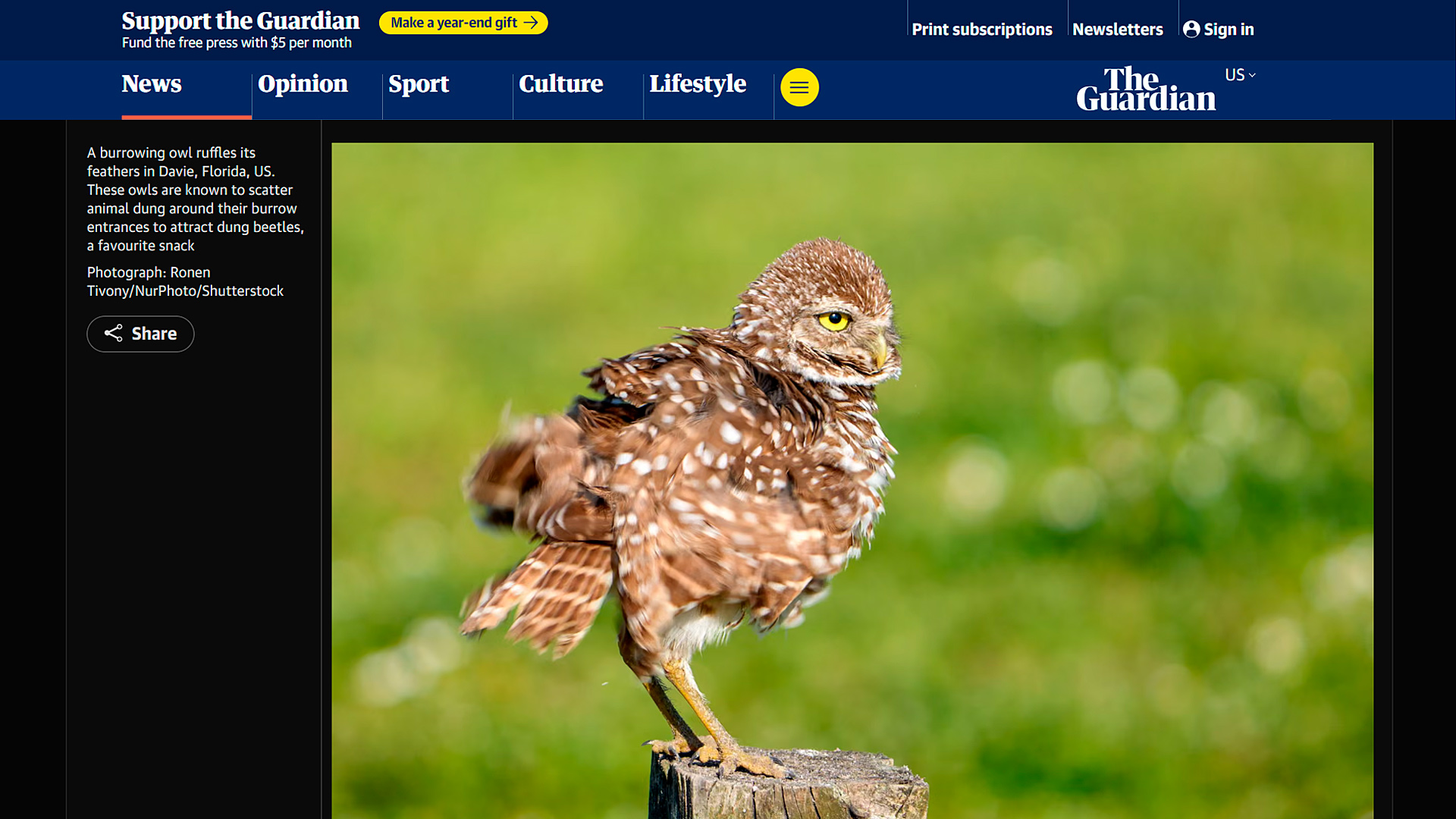
Burrowing owls in Florida are one of the most charismatic and accessible wildlife subjects in the state. When one of my images from Davie, Florida was selected for The Guardian’s “Week in Wildlife: This week’s best wildlife photographs from around the world,”
The published caption read:
“A burrowing owl ruffles its feathers in Davie, Florida, US. These owls are known to scatter animal dung around their burrow entrances to attract dung beetles, a favourite snack. Photograph: Ronen Tivony”
Why Burrowing Owls in Florida Are So Fascinating
The burrowing owl (Athene cunicularia floridana) is unlike any other owl in North America. Most owls are nocturnal, hidden in forest canopies, and rarely seen. Burrowing owls break every rule. They live underground, spend much of their time standing in plain sight at the entrance to their burrows, and are often active during daylight hours. For wildlife photographers, that accessibility makes them extraordinary subjects.
Florida’s burrowing owls belong to a distinct subspecies found primarily in Florida and the Bahamas. They stand just seven to nine inches tall, with a wingspan of around 21 inches. Despite their small size, they are fierce hunters. They feed on insects, small lizards, frogs, and rodents. They also have one of the most fascinating behavioral quirks of any bird in Florida: the dung-baiting strategy described in The Guardian caption.
Burrowing owls scatter mammal dung around their burrow entrances. Research published in the journal Nature by University of Florida scientists confirmed that owls with dung at their burrows consumed ten times more dung beetles than owls whose burrows were cleared of dung. The owls are using the dung as bait, luring beetles directly to the entrance where they can be caught with minimal effort. It is a documented form of tool use in a wild animal and one of the most clever foraging strategies in the bird world.
The Best Locations Across the State
Burrowing owls in Florida are found across much of the peninsula, with the highest concentrations in the south and southwest. Below are the most reliable and photographer-friendly locations.
- Davie, Broward County: The location of The Guardian image. Established owl colonies along roadsides and open lots. Reliable year-round.
- Cape Coral, Lee County: One of the single largest burrowing owl populations in Florida. Multiple active colonies within easy reach of each other.
- Near Miami (Owl Photography Workshop with Ronen Tivony): Prime owl habitat just one hour from Miami, with expert-guided photography sessions available.
- Kissimmee and Osceola County: Inland populations on open pasture and grassland habitat.
- Marco Island, Collier County: Coastal population with good year-round accessibility.
- Pembroke Pines, Broward County: Active suburban colonies with easy public access.
Best time for burrowing owl photography in Florida: Burrowing owls in Florida are year-round residents. Spring is the most active period, when nesting is underway, owlets are visible at burrow entrances, and adult behavioral displays are at their most frequent. Early morning light produces the best conditions, as the owls are most active before midday heat.
Photograph Burrowing Owls in Florida with Ronen Tivony
I lead guided owl photography workshops near Miami focusing exclusively on Florida’s burrowing owls. Sessions run three to four hours and are tailored to all skill levels, from beginners learning the fundamentals of wildlife photography to experienced photographers working on specific behavioral shots.
Every session includes personalized in-field instruction on technique, behavior reading, and ethical approach. Post-session image review is also available.
View the full Florida workshop schedule or contact me directly to book a private session or ask about availability.
Ronen Tivony is a Florida-based wildlife photojournalist and workshop leader with three decades of professional photojournalism behind him. His wildlife images have been published in The New York Times, National Geographic, The Guardian, CNN, BBC, Smithsonian Magazine, The Wall Street Journal, The Atlantic, USA Today, TIME, and many other major outlets worldwide