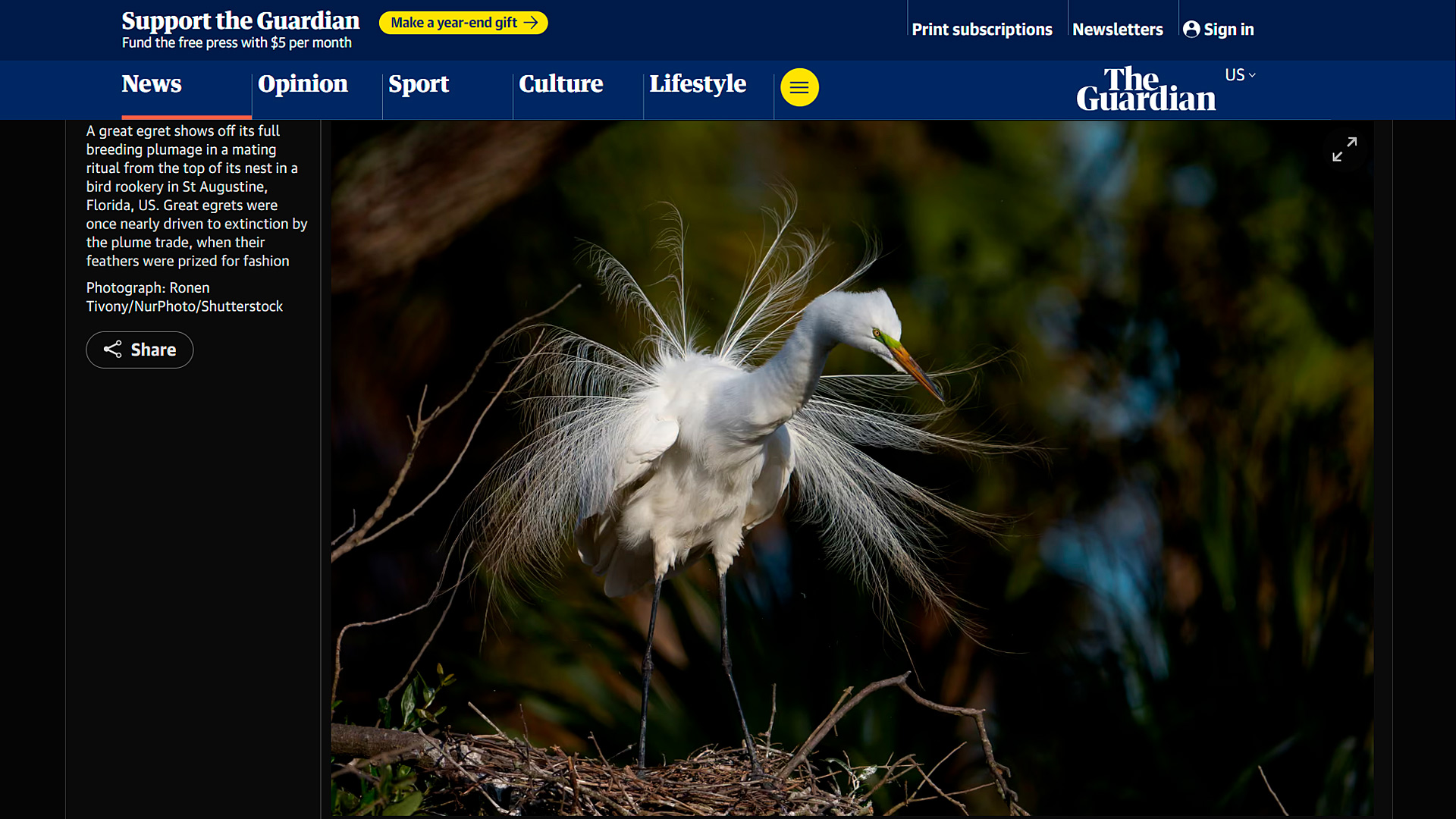
Great egret photography in Florida is at its most spectacular during spring breeding season. This year, an image I made at the St. Augustine bird rookery was selected for The Guardian’s “Week in Wildlife: This week’s best wildlife photographs from around the world.”
The published caption read:
“A great egret shows off its full breeding plumage in a mating ritual from the top of its nest in a bird rookery in St Augustine, Florida, US. Great egrets were once nearly driven to extinction by the plume trade, when their feathers were prized for fashion. Photograph: Ronen Tivony”
What Makes Great Egret Photography in Florida So Extraordinary
The great egret (Ardea alba) is one of the most iconic subjects in Florida bird photography. It stands up to about three and a half feet tall with a wingspan of nearly five feet. That makes it one of the largest white wading birds you will encounter in Florida’s wetlands. Great egrets are year-round residents across the state, so they are reliably accessible. During breeding season, however, they become something else entirely.
In late winter and spring, great egrets grow aigrettes: long, delicate plumes that cascade from their back. These feathers only appear during the breeding season. They are used exclusively in courtship displays. When a great egret fans its full aigrette plumage, spreads the feathers wide, arches its neck, and calls from the top of its nest, it delivers one of the most dramatic wildlife spectacles Florida has to offer.
The lores (the bare skin between the eye and bill) also shift to vivid lime green during peak breeding condition. This adds an unexpected flash of color to an otherwise all-white bird. Combined with the yellow-orange bill, jet black legs, and cascading white plumes, a breeding-condition great egret is one of the most visually striking birds in North America.
For anyone serious about great egret photography in Florida, the breeding season window from late January through April is when you want to be in the field.
St. Augustine, Florida
When it comes to great egret photography in Florida, the St. Augustine bird rookery stands apart from every other location.
St. Augustine hosts one of the most accessible and productive colonial waterbird rookeries in the eastern United States. During spring nesting season, dozens of species crowd the rookery at the same time. Great egrets, great blue herons, tricolored herons, snowy egrets, roseate spoonbills, white ibis, and anhingas all nest within feet of each other. The density of breeding behavior is extraordinary.
For great egret photography specifically, St. Augustine offers four key advantages:
- Proximity: Nesting birds can be photographed at close range without disturbance, enabling frame-filling compositions that reveal feather detail, eye color, and expression.
- Behavior: Courtship displays happen continuously during peak season, including aigrette fanning, neck stretching, bill-clapping, vocalizing, and mate interaction. Behavioral moments are never scarce.
- Light: The rookery’s open canopy allows excellent morning light. Warm early sun against bright white plumage creates the luminous, glowing quality that defines the best great egret images.
- Reliability: Unlike many Florida wildlife locations where success depends on luck, the St. Augustine rookery delivers consistently each spring when birds are in breeding condition.
Great Egret Photography in Florida: Top Locations Statewide
St. Augustine is the crown jewel, but great egret photography in Florida rewards exploration across the whole state. Below are the locations I return to most consistently.
- Wakodahatchee Wetlands, Delray Beach: A constructed wetland boardwalk that puts you within feet of nesting great egrets, spoonbills, herons, and anhingas. It is one of the most productive bird photography locations in North America.
- Orlando Wetlands Park, Christmas: Excellent for year-round great egret activity, with superb foraging and flight behavior in open water settings.
- Everglades National Park: The Anhinga Trail, Mrazek Pond, and Nine Mile Pond offer outstanding great egret photography in a true wilderness setting.
- Fort De Soto Park, Pinellas County: Particularly strong for wintering and migrating egrets from October through February.
- Stick Marsh / Farm 13, Fellsmere: Less visited but highly productive, with great egrets foraging in open shallow water and strong flight photography opportunities.
- Corkscrew Swamp Sanctuary, Naples: An ancient cypress swamp with reliable great egret activity and extraordinary atmospheric light year-round.
Best time for great egret photography in Florida: Late January through mid-April is the peak window for full breeding plumage and active courtship displays. The first two hours after sunrise produce the best light and the most active behavioral sequences. Great egrets are present year-round in Florida, but the aigrettes are only visible during breeding season.
Bird Photography Workshops with Ronen Tivony
Do you want to photograph great egrets in full breeding plumage at the right locations, at the right time of year, and with expert guidance on positioning and technique? I would love to have you join me in the field.
I lead Florida bird photography workshops throughout the year at Wakodahatchee Wetlands, Orlando Wetlands, the Everglades, Fort De Soto, and other top locations. Whether you are working on your first wildlife images or aiming for international publication, my workshops are built around putting you in exactly the right place at exactly the right moment.
View the full Florida workshop schedule or contact me directly to discuss private instruction and custom tours.
About Ronen Tivony
Ronen Tivony is a Florida-based wildlife photojournalist and workshop leader with three decades of professional photojournalism behind him. His wildlife images have been published in The New York Times, National Geographic, The Guardian, CNN, BBC, Smithsonian Magazine, The Wall Street Journal, The Atlantic, USA Today, TIME, and many other major outlets worldwide.
In 2020, the Royal Photographic Society awarded him a Fellowship in recognition of technical excellence and a strong personal vision.
Ronen leads small-group wildlife photography workshops across Florida, including at Wakodahatchee Wetlands, Orlando Wetlands Park, the Everglades, Fort De Soto Park, and St. Augustine, as well as destinations beyond Florida including Bosque del Apache in New Mexico. When he is not in the field, you will likely find him on the water in a kayak, scouting the next location.