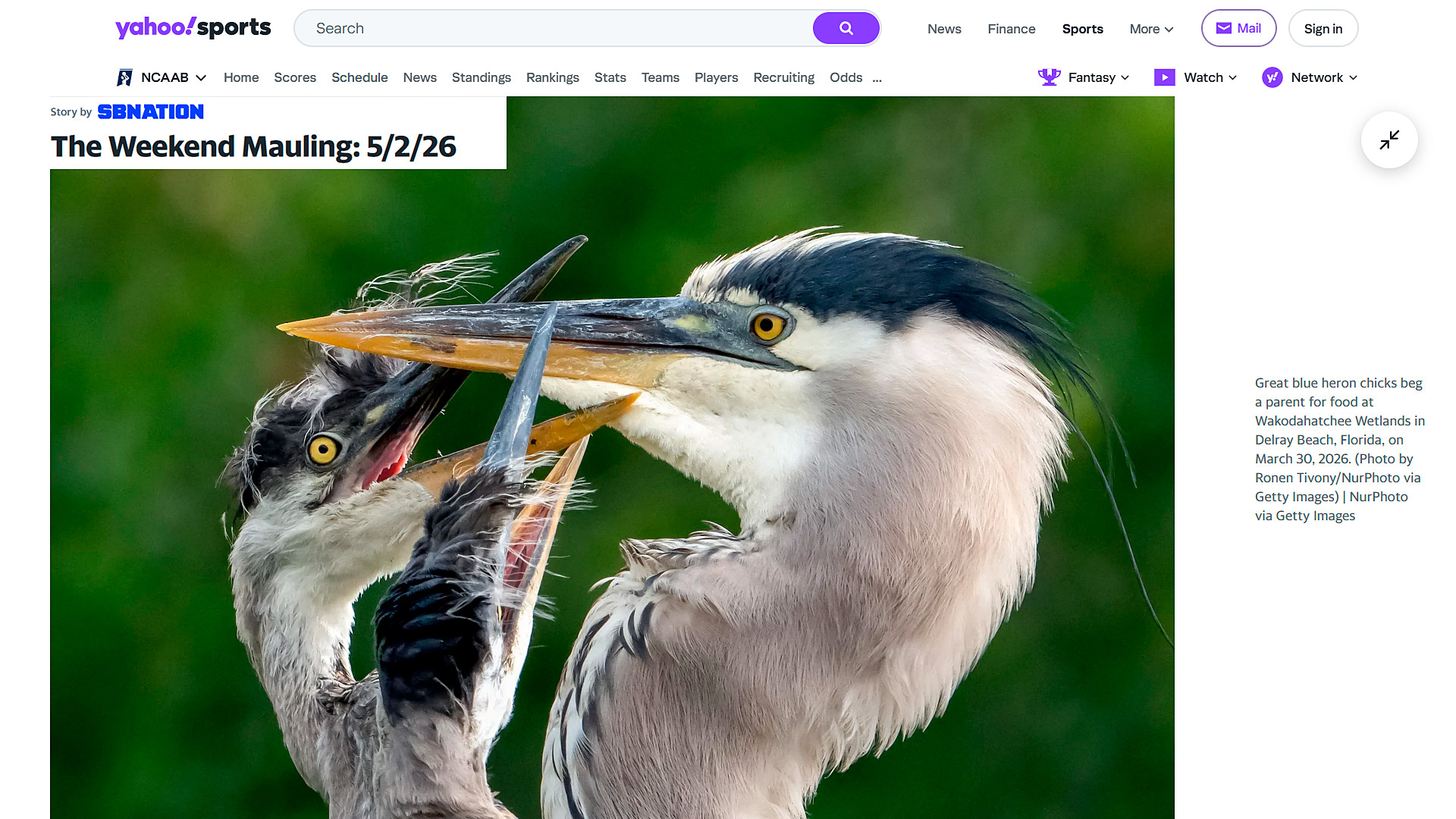
My photograph of great blue heron chicks at Wakodahatchee Wetlands was published this week in Yahoo Sports. The image shows chicks begging a parent for food at the nest, a behavior that plays out daily during nesting season at this Delray Beach location.
The published caption read:
“Great blue heron chicks beg a parent for food at Wakodahatchee Wetlands in Delray Beach, Florida. Photo by Ronen Tivony”
Why the Great Blue Heron Is Such a Compelling Subject
The great blue heron (Ardea herodias) is North America’s largest heron. It stands up to about four and a half feet tall. Its wingspan can reach six and a half feet. During the breeding season, these powerful, solitary hunters become something else entirely. They transform into devoted, tireless parents locked in a constant effort to feed their young.
Chicks hatch after an incubation period of approximately 27 to 29 days. Upon hatching, they wear a coat of pale gray down, with eyes open. They depend entirely on their parents for food and warmth. Both parents share feeding duties throughout the nestling period. They feed chicks by regurgitating food directly into the nest. The chicks respond with intense, outstretched begging behavior. It is one of the most photogenic moments in Florida bird photography.
The demand on parents is relentless. Researchers have documented parent herons consuming up to four times their normal food intake during the chick-rearing period. They forage throughout the day to keep up with their growing nestlings. Chicks stay in the nest for roughly 60 to 80 days before fledging. Even after their first flight, they return to the nest to receive food for several more weeks.
The begging moment itself is brief and unpredictable. The chick thrusts its bill toward the parent, neck extended, wings sometimes partially spread. Capturing it cleanly requires anticipation, fast shutter speeds, and the close access that Wakodahatchee makes possible.
Great Blue Heron Wakodahatchee: Why This Location Is Unmatched
For great blue heron photography, Wakodahatchee Wetlands in Delray Beach stands apart from any other location in Florida.
Wakodahatchee is a 50-acre constructed wetland that Palm Beach County manages. Workers built it in 1996 to treat reclaimed water. Today it ranks among South Florida’s most productive bird rookeries, with over 178 recorded bird species. The name comes from a Seminole word meaning “created waters.” A three-quarter-mile elevated boardwalk loops through open water, marsh, and nesting islands. It puts photographers directly at eye level with nesting herons, egrets, spoonbills, anhingas, and more.
Four factors make great blue heron photography at Wakodahatchee exceptional:
- Proximity: The boardwalk passes within feet of active nests on the islands. Photographers capture chicks, parents, and nest interactions at ranges that reveal expression, feather texture, and behavioral nuance. This level of access is genuinely rare.
- Consistency: Great blue herons nest at Wakodahatchee every year. When the season is active, nesting action runs from first light through mid-morning without interruption.
- Mixed-species colonies: Great blue herons nest alongside great egrets, tricolored herons, snowy egrets, roseate spoonbills, anhingas, and white ibis. The boardwalk gives access to all of them in a single session.
- Light: The open-water setting and boardwalk direction deliver excellent early-morning front lighting on most nest positions. Arriving 30 to 45 minutes before sunrise pays off consistently.
In South Florida, great blue heron nesting at Wakodahatchee typically runs from December through April. Chicks appear in nests from approximately February onward. The feeding behavior in this Yahoo Sports image is most intense in the early weeks after hatching. That is when chick energy demands peak.
Join a Wakodahatchee Bird Photography Workshop with Ronen Tivony
Wakodahatchee Wetlands is the centerpiece location for my Delray Beach bird photography workshops. Sessions are structured around the nesting season to put you at the boardwalk during peak feeding activity, in the best light, with personalized instruction on technique, behavior anticipation, and composition.
Whether you are photographing your first bird nest or building a portfolio aimed at publication, the combination of Wakodahatchee’s access and guided instruction produces results that are genuinely hard to replicate anywhere else in Florida.
View the full Florida workshop schedule or contact me directly to book a session or ask about availability.
Ronen Tivony is a Florida-based wildlife photojournalist, Fellow of the Royal Photographic Society, and Certified Florida Master Naturalist with three decades of professional photojournalism behind him. His wildlife images have been published in The New York Times, National Geographic, The Guardian, CNN, BBC, Smithsonian Magazine, The Wall Street Journal, The Atlantic, USA Today, TIME, and many other major outlets worldwide.